
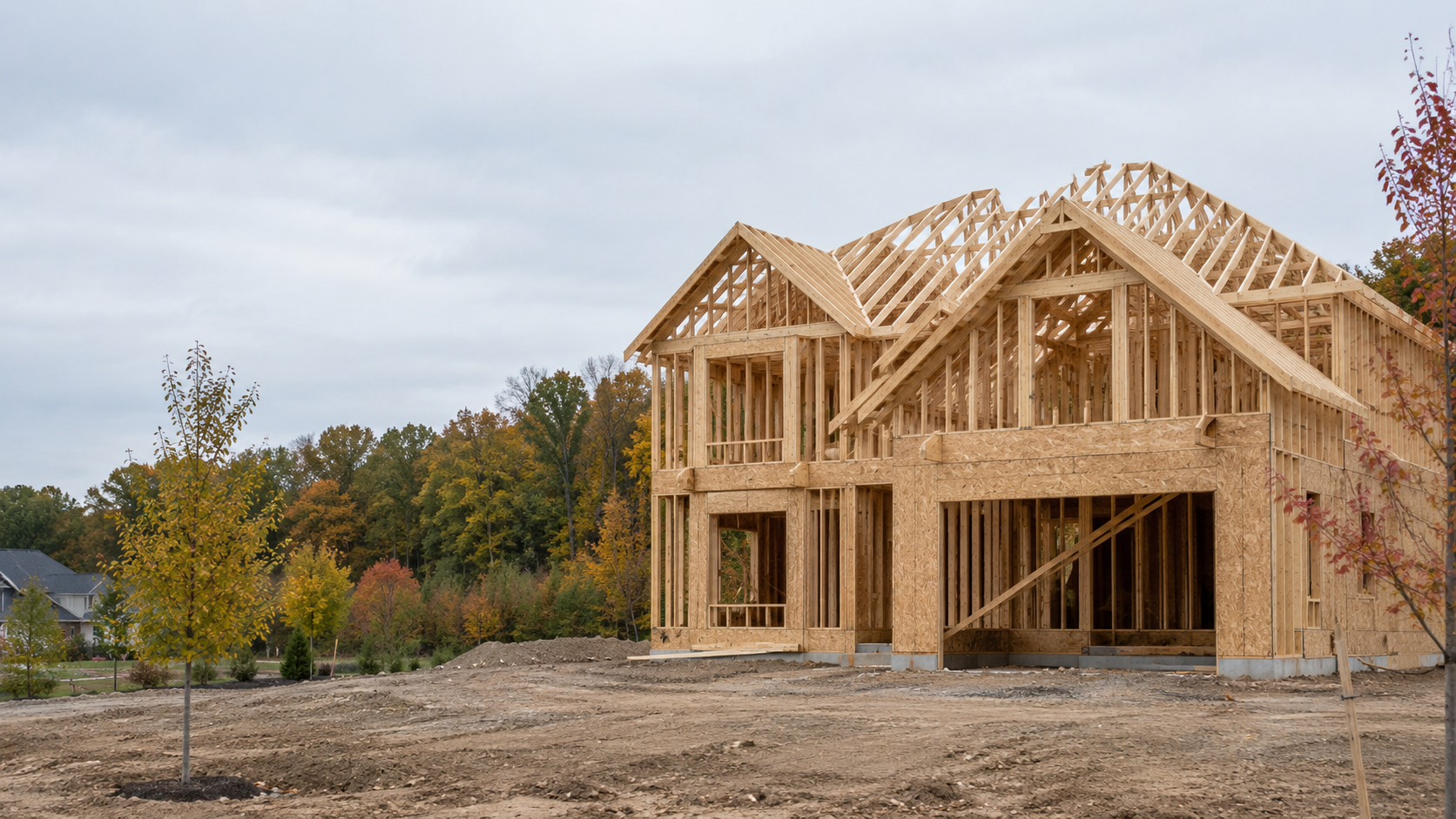
12 Questions to Ask Before Buying New Construction in Oakland County, MI
Buying new construction in Oakland County, Michigan works differently from buying a resale home. There is no listing agent across the table.
There is a sales representative in a model home, paid by the builder, and most buyers walk in alone without knowing it. These are twelve questions to ask first, and the answers that should slow a buyer down.
The twelve questions, in short:
- Who the sales rep works for
- Registering your own agent at visit one
- The builder's contract, not the standard form
- Base price versus final price
- The design center and the margin
- Lot premiums and what they buy
- Which school district the lot sits in
- Early phase lot or final phase
- Build timeline and late delivery
- Financing and rate locks over a long build
- What the builder's warranty excludes
- Independent inspections during and after the build
1. Who does the builder's sales representative actually work for?
The person at the model home desk is paid by the builder and represents the builder. That is a business relationship, not a personality trait. Most reps are friendly and useful. What they cannot do is advise a buyer to offer less, walk away, or take a rival development seriously.
A straight answer sounds like this: they work for the builder, and a buyer may bring separate representation. Oakland County realtors who show new construction say it before being asked.
A rep who claims to represent both sides, or says a buyer needs nobody else, is describing a convenience. Anything said at that desk reaches the builder.
2. When do I have to register my own agent, and what happens if I do not?
Most builders require a buyer's agent to be present or registered at the buyer's first visit to a community. Sign in alone on a Saturday drive through Oakland County, and the builder can refuse to recognize an agent brought in later. The policy is written down and rarely explained at the door.
A strong answer is the written policy itself, handed over on request, naming the form and the deadline. Ask about registration before signing the visitor sheet, not after.
A rep who waves the question off has a reason to. Buyers already sign a written agreement with their own agent before touring, under the changes of August 2024.
3. Whose purchase agreement am I signing, and what is missing from it?
New construction runs on the builder's own purchase agreement, not the standard form most Michigan resale deals use. Builder contracts are drafted by the builder's attorneys and favor the builder on the terms that matter: delays, changes, material costs, deposits and disputes. Several limit contingencies a resale buyer takes for granted.
A strong answer is a full copy to take home before any deposit, and a rep who can point to the delay, deposit and dispute clauses by page.
Being told the contract cannot be changed is a negotiating position, not a rule. Some terms really are fixed. Which ones is a fair question to ask out loud.
4. What is included in the base price, and what counts as an upgrade?
The base price buys the model with the least expensive finish package the builder offers. Flooring, cabinets, lighting, appliances, landscaping, a finished basement, even the width of a driveway can sit outside it. Buyers sign at one number and close at a much higher one, because every choice looked small.
A strong answer is a written list of what the base price covers and a price sheet for every option, handed over before a deposit, not after it.
A rep who holds option pricing back until the design appointment is managing the reveal. By then a deposit is down and the decision feels made.
5. How does the design center work, and where does the builder make its money?
The design center is where a base price becomes a final price. Builders often price upgrades above what the same work would cost from an outside contractor after closing, because the appointment is timed and the buyer is already committed. A large share of the margin sits there.
A strong answer hands over the option catalog and prices in advance, and confirms what can be added later. Structural choices have to be made early. Finishes often do not.
Pressure to decide everything in one sitting is the flag. So is a rep who cannot name one upgrade a buyer could add after closing for less.
6. What is the lot premium on this homesite, and what am I paying for?
A lot premium is money added to the base price for one homesite: a walkout, a wooded boundary, a pond view. Premiums are set by the builder, not by an appraiser. Some hold value at resale and some do not, and a view can vanish once the ground behind it is graded.
A strong answer names the premium and shows the site plan for the surrounding land. In Oakland County, where The Delia Group works, a buyer's agent can check what similar lots resold for.
A premium explained only as demand for that homesite is not an explanation. Ask what is approved for the ground behind it, and ask to see the recorded plat.
7. Which school district is this lot actually in?
School boundaries do not stop at a development entrance. Oakland Township, where Zillow put the average home value at $621,147 as of 31 January 2026, is split between Rochester Community Schools and Lake Orion Community Schools. Two new homes in one township can feed different districts. A builder's rep sells homes, not boundaries.
A strong answer is the district confirmed in writing for that lot number, checked with the district rather than a brochure. Oakland Township covers 36 square miles, so it can change inside one development.
Marketing that names a district for the community as a whole, with no address level confirmation, is the thing to check. Boundaries also get redrawn, which no builder controls.
8. Is this an early phase lot or a final phase lot?
Developments sell in phases, and the phase changes the deal. Early phase buyers usually pay less and carry the risk that the community stays unfinished, that the promised amenity never gets built, and that construction traffic runs past the house for years. Final phase buyers pay more and choose from fewer lots.
A strong answer is the phasing plan and what is approved for each phase, not just proposed. Top realtors in Oakland County track which developments in Rochester Hills, Lyon Township and Oakland Township are on schedule.
A rep who describes future phases as certain is describing a plan, not a permit. Approvals, timing, the amenity package and even the builder can change.
9. What is the build timeline, and what happens if it runs late?
A build timeline is an estimate until the contract turns it into a commitment. Weather, permits, inspections and supply all move the date, and Michigan winters move it most. What matters is what the purchase agreement says when the date slips: whether the buyer can walk, and whether the deposit comes back.
A strong answer points at the delay language and gives an outside date, not only a target. A buyer with a lease ending should ask what happens if closing moves twice.
A date given verbally with nothing in the contract behind it is the flag. So is a rep who cannot name one home there that closed late.
10. How do I finance a build, and what happens to my rate while it goes up?
A build can run many months, and most rate locks do not run that long. Builders often offer an extended lock or a rate buydown through their own lender, with an incentive attached to using it. Those incentives are real money. So are the lock length and the fees underneath them.
A strong answer compares the builder's lender against at least one outside lender on total cost rather than the headline rate: lock length, extension fees, points and closing costs.
An incentive tied to the builder's lender is not a bad deal by itself. A rep who discourages a second quote has answered the question.
11. What does the builder's warranty cover, and what does it exclude?
Builder warranties come in layers: a short period on workmanship and finishes, longer on systems, longest on structural elements. The exclusions are where the surprises live. Landscaping, grading, drainage, concrete cracking within tolerance and anything a homeowner altered are commonly outside coverage.
A strong answer is the warranty document itself before signing, with the claim process, the response times and the exclusions in one conversation. Ask who handles claims once the builder leaves.
A ten year warranty described as if it covered the whole house is the common one. The long tier is usually structural only, and that word is worth reading.
12. Can I bring my own inspector during the build and at the final walkthrough?
Municipal inspections confirm code compliance. They are not a quality inspection for the buyer. An independent inspector can look at the house before drywall closes the walls, and again before closing. The visit before drywall is the one buyers skip, and the only point where framing, wiring and plumbing are visible.
A strong answer is yes, with a note on scheduling and site safety. Two visits is the pattern: one before drywall, one before the final walkthrough.
A builder who refuses outside inspection, or allows it only after drywall, has limited what a buyer can find. Being told the municipal inspection covers it answers a different question.
Who Works for Whom in a New Construction Deal
| Role | Who pays them | Who they represent |
|---|---|---|
| Builder's sales representative | The builder | The builder |
| Buyer's own agent | Agreed in writing before touring | The buyer |
| Builder's preferred lender | Fees from the loan | Its own book of business |
| Independent inspector | The buyer | The buyer |
Everyone at a model home can be helpful. Only two of these roles owe the buyer advice.
Frequently Asked Questions
Do you need a realtor to buy new construction?
A builder's sales representative will run the paperwork without one. The trade is that nobody in the room works for the buyer. Buyers sign a written agreement with their own agent before touring, and who covers that fee is negotiated.
Can you negotiate on a new construction home?
Builders resist cutting the base price, because a lower recorded sale price affects every other home in the community. Movement shows up in incentives: closing cost help, an upgrade allowance or a lender credit. Get any incentive written into the purchase agreement.
How long does it take to build a house in Michigan?
It depends on the builder, the permit queue and the season, and Michigan winters slow site work and concrete. The number worth having is the outside date written into the purchase agreement, plus what happens if that date passes.
Is new construction more expensive than an existing home in Oakland County?
The comparison is rarely even once upgrades and a lot premium are counted. Redfin put the Oakland County median sale price at $397,335 for the three months ending July 2026, but that covers the whole county. Compare a new build against recent nearby sales.
Talk to The Delia Group before the first model home visit
The Delia Group is a real estate team in Rochester, Michigan working with buyers across Rochester Hills, Oakland Township and the rest of Oakland County. Builder registration rules make the first model home visit the one that counts, so that call belongs before the tour. Buyers comparing the best real estate agents in Oakland County can start there.
This article is general information about buying new construction in Michigan. It is not legal or tax advice. Have a real estate attorney review a builder's purchase agreement before signing it.

Subscribe to our Mailing List
Copyright ©2026 | All Rights Reserved 2026 | Privacy Policy | Terms of Service